Abhinav Kumar Dwivedi

Product leader tailored for the new internet. Building digital products that matter.

Sitemap

  • Index
  • Projects
  • Blog
  • About

Socials

  • LinkedIn
  • x
  • GitHub
  • Email
© 2026 All Rights Reserved
New Delhi,India / Remote

Designing for Learning Without Breaking YouTube

A product case study on improving learning continuity without turning YouTube into a course platform

0%

Designing for Learning Without Breaking YouTube

A product case study on improving learning continuity without turning YouTube into a course platform

View Deck!
Product Manager2025
Designing for Learning Without Breaking YouTube
01

The Challenge

I was learning JavaScript to build web projects. The content wasn’t the issue, YouTube already had plenty of high-quality, up-to-date explanations.

The problem appeared after I paused learning for a few months. When I returned, I couldn’t tell where I had left off. I rewatched videos I had already seen without realizing it. Progress indicators only showed video length, not learning, and offered no sense of continuity.

Playlists didn’t help. Tracking progress meant scanning videos and relying on memory, which quickly broke down, especially when learning multiple topics. The platform made it easy to start learning, but hard to resume it.

This wasn’t a credibility problem. It was distraction, poor discoverability of the right content, and the absence of meaningful progress tracking. Because of this, I abandoned the project midway and moved to Udemy and Coursera for serious learning.

02

The Goal

Primary Goal
Increase learning topic completion on YouTube. I wanted learners to finish what they started instead of dropping off due to distraction, loss of context, or unclear progress. Success meant improving completion from 38% to 50% within six months, not by adding courses, but by reducing friction in ongoing learning.

Explicit Non-Goal
I did not optimize for recommendation diversity, even though it would have helped short-term engagement. Prioritizing breadth would have worked against continuity and made sustained learning harder.

Tradeoff Boundary
I was willing to improve learning depth up to the point where it didn’t fragment the core recommendation system or force learning intent onto casual users.

Who Benefits
Focused learners working on multi-session topics benefit most. Casual, exploratory viewers benefit least, and that was an intentional choice.

Overview

YouTube is one of the most common places people go to learn, but it isn’t designed for sustained learning. The issue isn’t content or credibility, it’s continuity.

The platform is optimized for discovery, watch time, and scale, while learning requires focus, memory, and progress over time. These goals are often in direct conflict.

I deliberately chose not to turn YouTube into an education platform or propose a separate “YouTube Edu.” That would have avoided the product’s real constraints.

YouTube’s recommendation and ad systems are built to maximize engagement, not support distraction-free learning journeys. Optimizing purely for learning depth would hurt reach, creator uploads, and revenue.

This case study shows how I decide when depth is worth pursuing inside a mass-scale consumer product, and when it isn’t.

In-Depth Analysis

Context & Constraints
01 — The Context

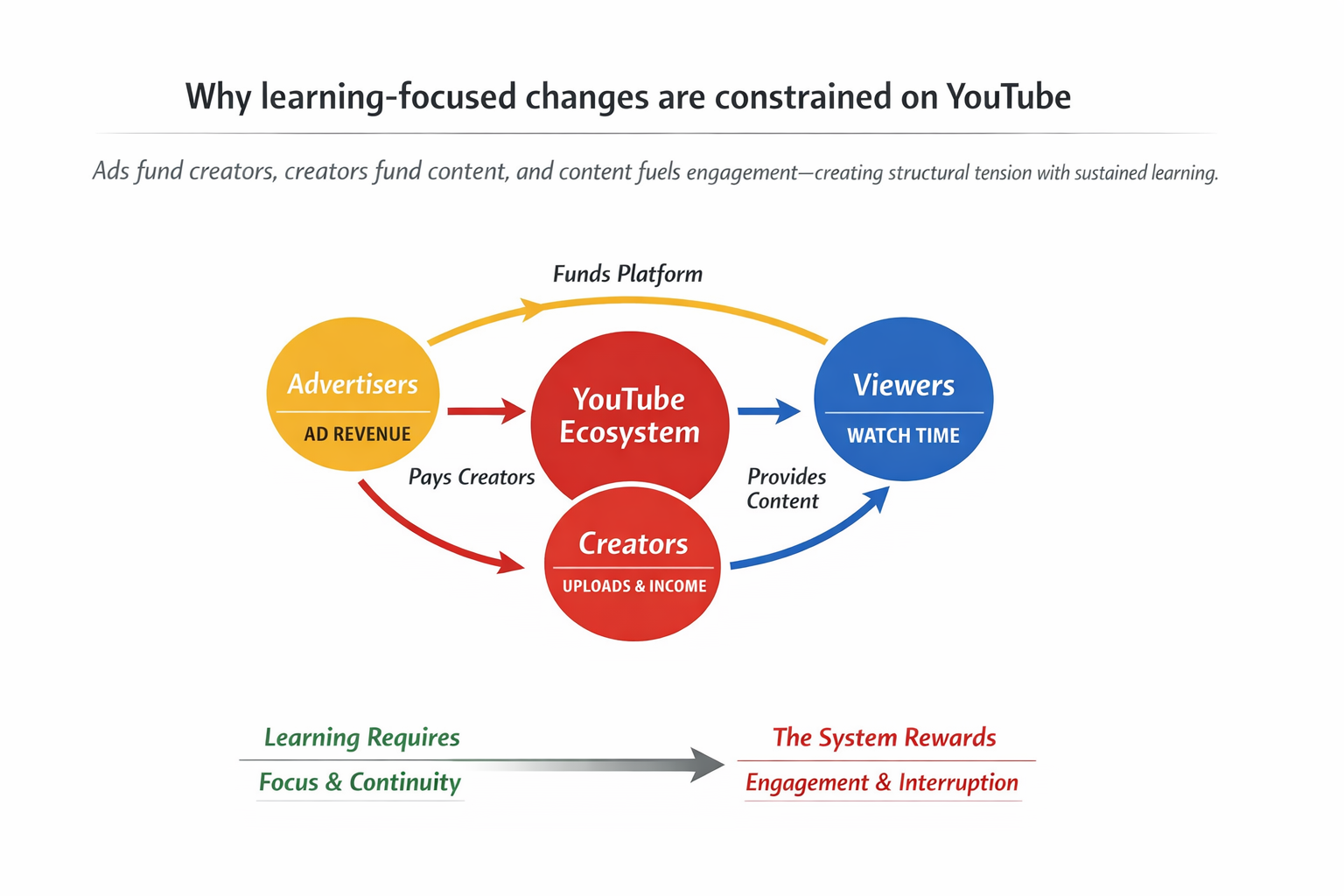
YouTube is optimized for single-video engagement and ad impressions, not structured learning. Its core systems reward discovery and continuous watching, not long-term progress.

Ads are structurally unavoidable. They fund creators, content volume, and free global access. Reducing ads for learning content would weaken creator incentives and degrade the ecosystem that sustains watch time.

The strongest internal pushback would come from content partnerships. Creator income depends on reach and ad exposure, and learning-oriented content often performs worse on engagement metrics.

Most creators optimize for watch time and low drop-offs, while structured learning requires slower pacing and repetition, patterns the algorithm does not reward.

Not all users come to YouTube to learn deeply. Designing for sustained learning intent would introduce commitment and narrow recommendations, hurting passive, curiosity-driven viewing.

I chose not to build a separate “YouTube Edu.” Splitting learning into another product would compromise the recommendation system and avoid the harder constraint of improving learning within YouTube’s core experience.

Key Insights

The Product Approach

Stage 01

Problem hypothesis

I started with a focused bet: learners drop off on YouTube because they can’t track progress or resume learning across sessions. This framed the work around retention and completion.

1
Stage 02

Hypothesis validation

Surveys, interviews, and secondary research confirmed continuity as a real issue at scale. Learners relied on memory, playlists, or notes and still lost context.

2
Stage 03

Root cause prioritization

From multiple issues—distractions, discoverability, credibility—I treated progress tracking as the root problem. Without continuity, other improvements had limited impact.

3
Stage 04

Scope and tradeoffs

I focused on structured, multi-session learning and excluded short how-to content and certifications. Designing for both would have diluted impact.

4
Stage 05

Direction selection

I rejected UI-first fixes and a separate “YouTube Edu.” Those options avoided the harder constraint of improving learning within YouTube’s core ecosystem.

5